
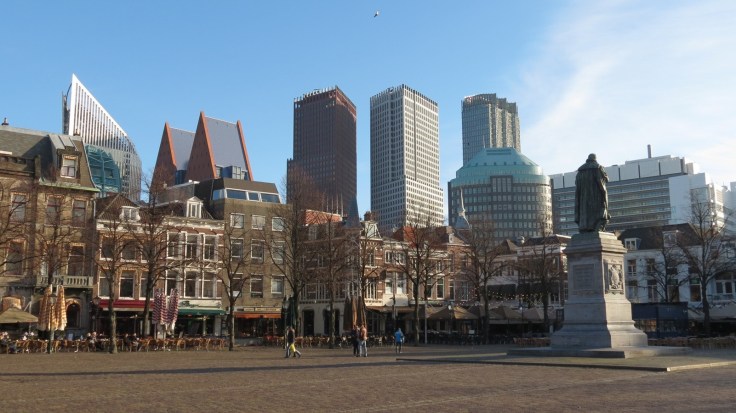
Taking a break from Amsterdam, I went to the city of the Hague for a few days after returning from London where it was still flip-flop weather. I stayed at my friend’s Alice, who I’ve known since secondary school. She has always had high-flying jobs since graduating from uni and back in the days we regular met in London, where she often travelled to for work.
What’s in a City
To Amsterdam locals, the Hague, the Netherlands’ third city and the seat of the central government and the Dutch royal house, is a bit boring. This is understandable from the capital’s perspective, as most Amsterdam locals think their city is the centre of the universe, but it is not necessarily true. For some odd reason I have quite a few girlfriends who originate from the Hague and in in my acting days I really enjoyed working there. The Hague in dutch is Den Haag and it’s official name is ‘s-Gravenhage, which absolutely no one says. The longer version literally means ‘of the counts’ hedge’ and the short version ‘(of) the hedge’. The Hague is technically not a city as it hasn’t got city rights. There are no reliable sources that can confirm any human activity in the area now called the Hague prior the 12th century until a certain count decided to buy a court there. After this count was crowned King of the Romans in the middle of the 13th century, he rebuilt that court to a royal palace and it was named the Inner Court. From the mid-13th century onward the counts of the Lowlands used the Hague as their administrative centre and main residence and it has been a centre of political activity ever since.
The Hague’s Class
In Dutch the Hague is referred to has the Court City. It’s is a stately, very international and multicultural and the only city of considerable size in the country located at the coast. The city houses many embassies and international institutions like the International Court of Justice and the International criminal court. The Hague attracts a fair amount of tourists, but most definitely not at hysterical Amsterdam- levels. This could be changing though, to the horror of most locals. Even the powers/ idiots that opened the tourist flood gates realise that visitor numbers in Amsterdam have indeed got out of control, and other cities, like the Hague could take on parts of the tourist masses. The Hague is typified as a city with a rather stratified population. In general, Dutch folks believe in flat structures and although it is by no means a classless society, it is most definitely not as class-aware as the UK and almost the opposite of an incredibly stratified country like India. However, the Hague has its ‘chavs’, a term I don’t particularly like, and its snobs. With the exception of the artistic class and a few salon socialists, there is not much in between. The city has the Dutch equivalent of a polytech, but no university. There are renowned universities in very nearby Leiden to the northeast and Delft to the southwest. Despite- or maybe because- of its political and royal character, the city has always known an interesting artistic scene with a loyal following. The Hague’s crowd is much kinder in their expression towards artistic endeavours compared to Amsterdam folk who think they’ve seen it all and are notoriously hard to impress. The city’s must-see exhibitions include those on 17th, 19th and 20th- century greats Vermeer, Mesdag and Esscher.
My friend Alice absolutely loves it in the Hague and I can see why. It might not be as swanky as Amsterdam, but neither is it as pretentious and full of itself. It is smaller, you can still enjoy the city centre without being heavily annoyed by tourists and the sea is close by. What probably truly is the country’s swankiest city is only a 10-minute train-ride away and if you do want to visit the capital, you can reach it by train within 50 minutes. The Hague might be boring, but it ‘does ‘boring’ in rather interesting ways.
 Dark Fairy Adventures
Leave a comment