
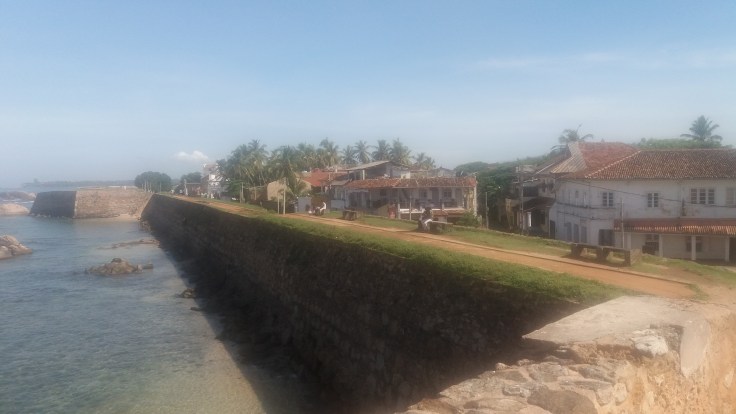
After my two-night stay in Mirissa, I took a bus ride an hour or so to the west, to the fortress town of Galle, of which the English pronunciation is Gaul, as in the old name for France. The vast majority of the city of Galle is located outside of the fort, yet the fortified neighbourhood, is the main tourist attraction.
Galle; what’s in Colonialism
Galle has a very long history as a trading port, starting hundreds of years Before Common Era. The Indians and Chinese were coming and going, followed by other folks including Persians, Arabs, Greeks and Romans. The famous fort was initially built by the Portuguese in the 17th century, and after a trade war, the Dutch took over and rebuilt parts of the fortress walls. There is quite a lot of Dutch history in Sri Lanka and in Galle in particular. This particular history of Dutch merchants exploiting lands and goods in the East, is a bit of a peculiar one. To many, the history of the VOC, which stands for United East-India Company in Dutch, is a reason for great Dutch pride. In primary school I was taught about the trading successes of the Company, making the Netherlands a strong maritime nation and the country and Amsterdam in particular very wealthy. This period in Dutch history is referred to as the Golden Age. About a decade ago, the then Dutch prime minister mentioned the term VOC mentality’ in parliament in reference to the nation’s economy and how ‘we’ could prosper once more, just like in the VOC days in the 17th and 18th century. The then prime minister referred to the merchant mentality of the Company, yet many MPs and member of the public found his words very inappropriate and rightly so. The VOC was a public trading corporation and functioned as a state within a state. It was a corporate entity, that not only could make trade agreements on the government’s behalf, but it could also govern occupied territories and declare war, which it has done several times. The Company exploited many regions in the East, with little or no regards for the foreign lands and its people. The Dutch only established trading posts along the coast of Sri Lanka, which they called Ceylan, and were never interested in colonising the whole island. After a lost war against the English, the ‘Dutch parts’ of the island were ‘transferred’ to the British, who had the aim to colonise the whole island and, as the only foreigner power to ever do so, that’s what they did.
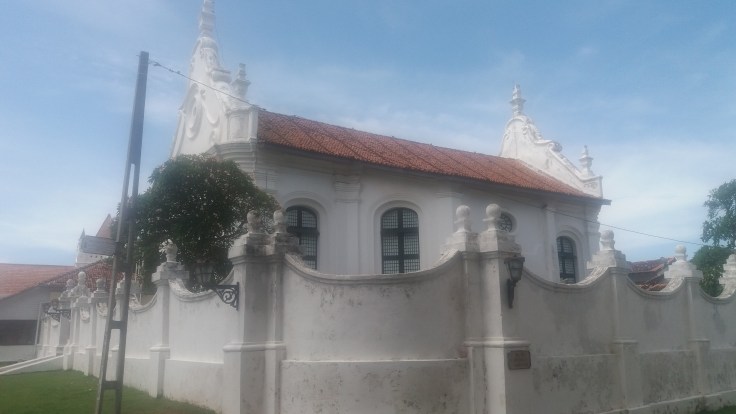
The Dutch left their mark in Sri Lanka and in addition to forts in coastal cities like Colombo, Galle and Matara, there are a fair amount of Dutch churches. Furthermore, VOC coins, weapons and other artefacts are on display in several museums, including the national museum in Galle.
Tourist Herds and Heritage
Galle is not Amsterdam or Venice in terms of tourist herds, but the fort, which is a UNESCO heritage site, is rather touristy nevertheless and with ever-increasing tourist numbers in Sri Lanka, it can only get worse. The fort is small and can be explored in a few hours. If you plan to stay for the night and you are on a budget, it’s better to find accommodation and food outside of the fort. Prices in shop and restaurants within the UNESCO heritage site are relatively high.
Dutch history, and VOC history in particular, is very present in Galle. As a Dutchie with migrant heritage, this is both familiar and strange. Familiar in the sense that it’s part of national history I learnt in school and strange, because it wasn’t my ancestors, who lived on the shiny side of that history. My ancestors were on the other side; the dark-skinned victims of the transatlantic slave trade, which also made the Lowlands tremendously rich. I don’t believe in white guilt, or guilt of any shade, as no one should be made to feel guilty or ashamed for what their ancestors did. It’s rather a question of acknowledgement, that mistakes have been made in the past and how the current consequences of those mistakes can be addressed.
Meanwhile, being a Dark Fairy from a country predominately inhabited by white people is confusing for some here, so I have been assumed to be from South Africa, Ethiopia or Jamaica, which is all fine. The ambiguity is comforting somehow.
 Dark Fairy Adventures
Leave a comment