
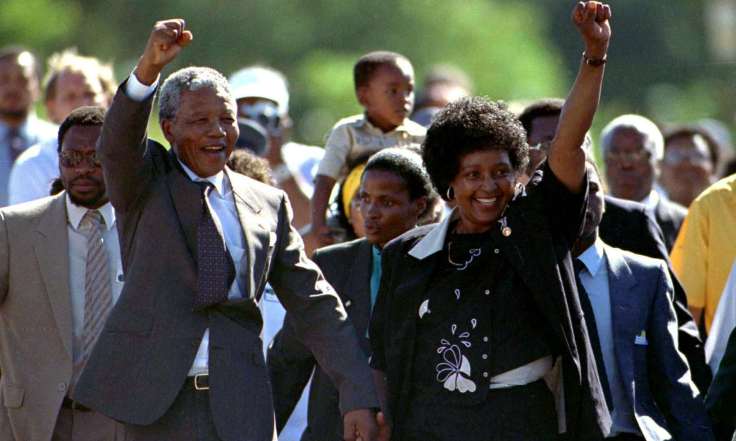
 Recent history knows many freak phenomena. The system of Apartheid was one of them. Being an 80s kid, I vividly remember the repeated news stories of black civil unrest and fierce repression in South Africa and the many anti-Apartheid campaigns that ran in the Netherlands. I remember the hits Free Nelson Mandela by The Special A.K.A and Sun City by Artist United against Apartheid, initiated by musician and activist Little Steven. I might have only been a kid, but I found it most baffling that people, who looked just like me, had absolutely no rights in their own country. As a grown-up and after almost a quarter of a century since the declaration of a free South Africa, I’m still astonished that the Apartheid system lasted for that long. One of the icons of that great struggle against Apartheid, Winnie Madikizela- Mandela has died recently. Since those days up until her death, she was considered a heroine and a controversial figure, as many women of that calibre and with similar profile tend to be.
Fearlessness and Militancy
A young Winnie met the much older Nelson Mandela in the late 1950s and they married about a year after their first meeting. They only spent a few years together, as in 1962 Nelson Mandela was sentenced to life imprisonment. During her husband’s incarceration Winnie Mandela campaigned tirelessly and fearlessly for his release and civil rights for the people of colour in South Africa. She was arrested, tortured, put under house arrest, intimidated and put under surveillance, yet this never stopped her fighting for the cause. As an intelligent and charismatic warrior queen she had a huge following and as the Apartheid government intensified its campaign against any opposition to keep the racist system in place, so did Winnie Mandela intensify her battle. This meant she was unforgiving to those she suspected of being informers of the regime and reprisals were brutal. In 1989 Winnie Mandela was found guilty of instigating the kidnapping and brutal murder of the 14-year old Stompie Seipie.
Ultimate Victory
Winnie Mandela leading her husband out of jail that sunny Sunday in February 1990 after 27 years of imprisonment, might remain one of the biggest historic television moments of my life. It was an image of strength, joy and ultimate victory. Yet, after that historic day, Winnie Mandela would get several more stains on her image as Mother of the Nation.
The first free elections for all South Africans in April 1994 brought an end to white minority rule and made Nelson Mandela president of the multicultural country. The struggle was over. Winnie Mandela held a post in her husband’s cabinet, from whom she had been separated since 1992, but was fired a year later after allegations of corruption. The couple divorced in 1996. The Truth and Reconciliation Commission, chaired by another anti-Apartheid icon Archbishop Desmond Tutu, was to assess what atrocities had been committed on both sides. Winnie Mandela showed no remorse for the kidnappings, tortures and murders that she had ordered. However, the Commission came to the conclusion in its final report that Winnie Mandela was “politically and morally accountable for the gross violations of human rights committed by the MUFC “ (the Mandela United Football Club, Winnie Mandela’s personal bodyguards).
Despite several accusations and convictions of fraud, she remained very popular and politically active. She was a fierce critic of her former husband’s policies as president, yet seemed to have remained close to him until his death in December 2013. After Nelson Mandela’s passing she got involved in a bitter dispute concerning his estate and legacies and lost a court case two years ago after having gone to court to lay claim on Nelson Mandela’s Eastern Cape home.
Fallible Heroine
The fight against the white minority Apartheid regime was addressed by the racist system with military might and on the television screens it looked very ugly indeed. All the atrocities not captured on camera or written about in newspapers, must have been far worse. As a warrior queen Winnie Madikizela- Mandela was militant, determined and fearless. She must have sacrificed a lot for the struggle. A big cause can blind and power corrupts. Madikizela- Mandela clearly wasn’t infallible, however I wondered if she would have been looked upon differently if she had been a man. Male political leaders and activists tend to be praised for their statesmanship, vision or determination when they pass on, even if wasn’t all that rosy (Nixon, Arafat). Yet, women of the same profile don’t seem to get the same treatment (Indira Gandhi, Thatcher).
Madikizela- Mandela was and will remain a great heroine for many in and beyond South Africa. With her passing we are just being reminded that heroines and heroes are not saints and that our fallible heroines could be reviewed with the same kinder eye as their male counterparts, when they pass over to other realms.
 Dark Fairy Adventures
Leave a comment