

When it comes to beach bum towns in Costa Rica, it seemed a case of fourth time lucky, although in Dominical too, it was still low season. The hostel I stayed at was pleasant enough, yet, with a few exceptions, my roomies weren’t terrible social. After I connected with my dear friend Rick in Lowlands Country via Skype, as it was his birthday, I started to notice I missed a sense of community or at least more in-depth social interaction. I’m living my desired lifestyle, for which I’m very grateful, yet, like any other lifestyle, it’s not without its challenges.
Finding a Tribe
Despite these challenges and the occasional rain, I really connected with Dominical’s laid-back vibes. I had set up office in what I could call a jungle hipster cafe, with fantastic hippy food and views over the river mouth of rio Barú and the jungles beyond. My calls for more interaction were answered when two Spanish chicas came to stay in the dorm and another Spaniard had checked in sleeping in another dorm. In general, I’m very fond of Iberians, as they tend to be chilled, social and always up for a party. The four of us hit the sleepy town, where night action on low-season weekdays seizes at 10 pm. We talked about Spain’s latest constitutional crisis and the monarchy, us chicas being rather staunch republicans and the only male more ‘moderate’ and in favour of the royal family. The next morning I found male Spaniard Carlos at the soda next door – a soda is the Tico equivalent of the British caff- and we talked travel and location independent lifestyle.
Travelling on
I planned to travel to Puerto Viejo at the Pacific coast to get some more Caribbean vibes, but after my latest public transportation frustration, I decided I really couldn’t be bothered to spend ‘half my life’ travelling to the other side of the country via the capital San Jose and back again. When entering Costa Rica one needs to produce a ticket out of the country. For that purpose I bought a ticket from San Jose to Panama City in San Juan del Sur, which was expensive enough not the waste it. Puerto Viejo is close to the border with Panama and if it wasn’t for the bus to Panama, that departs from San Jose, I might have considered travelling to Puerto Viejo and from there to Panama. I left Domincal for San Jose, which, besides the hostel I stayed at, located in a beautiful colonial building and chats with a couple of interesting people, I found terribly uninspiring.
After two days of San Jose, I boarded a bus to Panama, only to do the exact same route back down south past Dominical. I arrived at Panama’s City’s main bus terminal at four in the morning, which is never an ideal time for a solo travelling woman, but besides being at the mercy of the taxi driver and especially the price he sets, three times the usual day rate for a local, nothing dramatic happened.
Casco Viejo de Panama: old versus antique
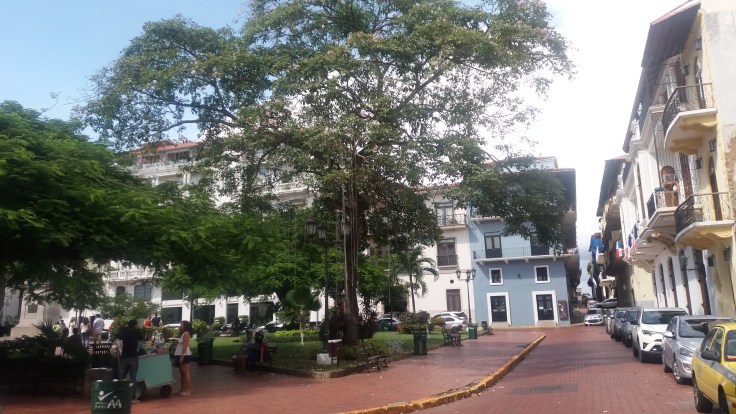
I had booked a dorm bed in an establishment that is a hotel offering highly overpriced rooms and very affordable dorm beds in the neighbourhood of Casco Viejo or Casco Antigua as it prefers to be called. Casco literally means helmet and could also be translated as shell. The neighbourhood prefers to be labelled as classic or antique, rather than old ‘cause ‘old’ is just dusty and smells of decay and ‘classic’ has an air of timelessness. Interestingly enough, the neighbourhood has bits of both. There is both a lot of dilapidated as well as beautifully renovated building in bright and less bright colours. It is Panama city’s historical district, and like so many old neighbourhoods in cities across the world, the place is gentrifying at a scary pace. Not that long ago the neighbourhood was considered a no-go area. Now there is a large military and police presence, making the prettiest parts of the neighbourhood safe, yet there are still parts of the hood, where traveller- tourists are advised not to go, even during the day. A certain degree of gentrification can be great to bring life and money to poorer and dilapidated neighbourhoods. Yet, there always seems to come a moment in that process, where the scales tip and the place becomes too expensive and too hipster and the residents, who lived in the hood in the early days get pushed out. This happens across the world. Just like Costa Rica, Panama and Panama City and the neighbourhood of Casco Viejo in particular, is popular with gringos and especially those with money. To my great astonishment, a fair amount of Americans that have been living in Panama for years and own businesses, speak very dodgy Spanish, if any Spanish at all. As a follower of the Yogic Path, I shouldn’t judge, but it’s work in progress and I do judge. Sure, in my native Lowlands Country they have been- and still are people- who came from southern Europe, North Africa and other places. They have been in the country for decades and owned or still own businesses like shops and restaurants and their Dutch is very poor. Yet, Dutch is a far more difficult language to learn and Dutch society seems far less open to non-western foreigners, especially since the early noughties. At the turn of the century it came fashionable ‘om te zeggen wat je denkt’ or speak your mind about those bloody ‘foreigners’, including the ones, who were born in the country or have lived in the Netherlands all their lives, so are not foreigners. But I’m digressing.
Panama City is considered Central America’s most forward-looking city and with a bunch of shiny high-rise buildings, and a strong presence of ‘expats’ and gringo pensioners, one can see why. There is a yoga studio a stone-throw away from my hostel- hotel and I have been indulging in a more vigorous style of yoga almost every day for a week and a half. There are some very interesting aspects to Panama City, including that engineering wonder that is the Panama Canal. Yet, I’m still not feeling the Central American urban vibes, which is okay, as the beach is calling.

 Dark Fairy Adventures
Leave a comment