
After my Lake Apoyo jungle hike and the frustration it gave me- see previous post- I arrived at base camp at the back of the motor bike, that had delivered some much needed sugars. At base camp, which was a jungle lodge with a terrace overlooking the lake, I ordered some food to go and ate it in the taxi. It wasn’t the greatest of food for a too high a price, but as they say; beggars can’t be choosers. It had already gone dark before we arrived back in Granada. I had asked Swiss Guy, my hiking partner on the trek, whether he had enjoyed the hike and he said he did, but he found it way too long, which it was.
Nature Excursions and Lessons in Life
When I got to my room in a popular hostel in town, I felt the day had been a valuable lesson on multiple levels. On a practical level I could have prepared better for the trek by having a decent breakfast and bringing along some food. At least I had brought an extra litre of water, as the litre and half provided at the beginning of the track, were gone by 1-ish. On another level it taught me something about vulnerability; I’m practising being okay with being vulnerable and not in my strength. This might sound random to some, but I’m sure any independent, solo travelling female, who also might be quite strong physically, can relate. Despite wanting to be in my strength, as the world is full of whiners and people celebrating their victimhood, it’s okay that I felt weak. It was okay that I needed to depend on the kindness and perhaps the patience of others. It’s okay that I didn’t really enjoy myself for most of the day. Not everything in life is fun, although we want it to be and besides all that, I didn’t pay for the excursion. Not that I was deliberately dodging payment. When I got back to the hostel I realised that no one had asked me for funds and I wasn’t chased down later, so I considered it a life lesson that hadn’t cost me any money.
After the Lake Apoyo expedition, I didn’t engage in any more nature outings until the end of my stay in Granada and most of the time I just wandered around town in search of chilled places, where they had good food and reliable wifi. An excursion I didn’t want to give a miss was a visit to the active Masaya volcano, as I only know lava lakes from National Geographics and other nature documentaries.
Masaya Volcano; Portal to the Fire Dimension
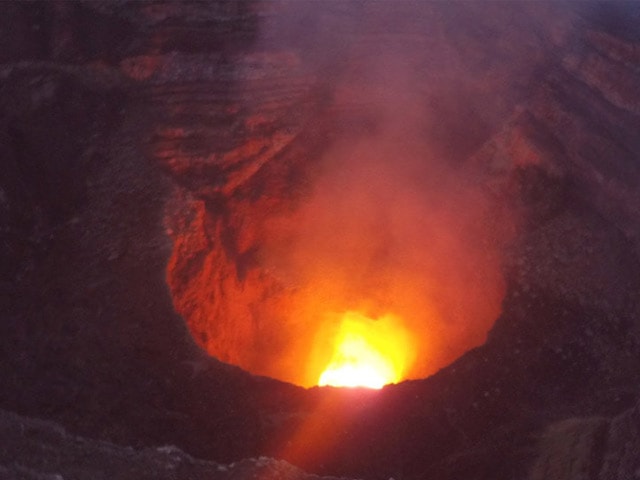
The Masaya volcano is part of a national park with the same name, which can be visited at day time to enjoy the views and visit the exhibition at the Visitors Centre. The park has hiking trails, but these are currently closed to the public. One can visit the park after dark as well until around 8 o’clock in the evening to stare into the lava lake of the Masaya volcano crater, which is quite a magical experience. Once you reach the look-out, or rather look-down, point you are at safe distance of the crater and you need to stand at a certain angle to get a good view of the glowing lava. You’re allowed to stare into the caldera for about 15 minutes after which I would think it becomes too dangerous to continue inhaling the volcanic fumes.
Throughout the ages people have been attracted to the element of fire. Besides giving light and warmth, it also seems to mesmerise, as most people can stare into a fire for eons. Fire can also be destructive as can be experienced during and after a wildfire or volcano eruption. Yet, a little fire can make the earth fertile again and the flanks of volcanoes provide very fertile soil, so despite the danger, rumbling mountains continue to attract human settlement and activity. There are many myths from all corners of the world about volcanoes. Some tell tales of fiery gods, others of volcanoes as portals to the underworld or the Christian concept of hell. The indigenous people of the Masaya region believed the volcano of the same name, which means ‘fire’ in the indigenous Chorotega language, was a god and home to a sorceress. Spanish bastards arrived in the region in the 16th century to rob and fuck up the land and they brought with them, besides death and destruction, the idea that the Masaya volcano was a source of diabolic activity. Spanish friar Francisco de Bobadilla dragged a cross up the volcano to exorcise what he believed was the month of hell. Another brother who went by the name of Blas del Castillo seemed far less considered with ‘heavenly’ matters and far more greedy, as he descended into the crater believing the lava lake was made up of liquid gold.
Tales of the Fire Element
In many esoteric traditions the element of fire is considered a portal to a different world or dimension. In both Islamic and pre- Islamic traditions of the Arab world, the jinn, super natural creatures also known as genies, are made of smokeless fired opposed to humans, who are considered to be made of clay. Some Christian traditions believe that demons manifest themselves in this reality through the element of fire. In the yogic and other tradition fire is associated with will and determination. In ancient Greek mythology the god Prometheus, one of the Titans, who wasn’t condemned to the Tartarus after the great battle, stole fire fire from mount Olympus to give it to mankind. (It was really mankind rather than humankind, as women weren’t considered quite human in ancient Greek times). As punishment for this Titanic crime, Zeus tied Prometheus to a cliff in the Caucasus for his liver to be picked out of his body by an eagle every day only for it to grow back during the night. As ancient Greek gods were considered immortal, but could feel pain like humans, Prometheus was to suffer until the end of time. Prometheus is considered a hero to humanists and luciferians of both past and present.
What’s in a Volcano
Modern day volcanologists don’t do folk tales, as conventional science and mythology don’t mix. According to them volcanoes just gives us a scientific inside into the inner workings of our planet, yet the fascination and the longing for an unearthly link with igneous rumbling mountains remain.
top image: Welcome to Nicaragua.net
middle image: jewelexi.com
 Dark Fairy Adventures
Leave a comment